
Hot runners don’t usually cause problems right away. They build up slowly… and then suddenly you’re dealing with streaks, black specks, or inconsistent flow that wasn’t there before.
And once it starts, it rarely fixes itself.
Why hot runners are harder to clean than you expect
The issue is not just residue. It’s where that residue sits.
Hot runners operate at high temperatures, and over time, material degrades inside small channels, tips, and nozzles. You don’t always see it from the outside, but it’s there.
This kind of plastic processing contamination doesn’t flush out easily with regular material. That’s why problems keep coming back even after multiple cycles.
What most people try first (and why it doesn’t last)
Typical approach:
- run natural resin
- increase temperature
- push more material through
It might improve things briefly. But not fully.
Because the degraded material inside hot runners tends to stick. It needs something that can actually dislodge and carry it out.
This is why basic hot runner cleaning method attempts often feel like a temporary fix instead of a solution.
What actually works in real production
In most cases, effective cleaning comes down to using the right purging approach.
A proper purging material is designed to:
- reach tight internal areas
- remove carbonised buildup
- push out old resin completely
Instead of guessing, you’re actively clearing the system.
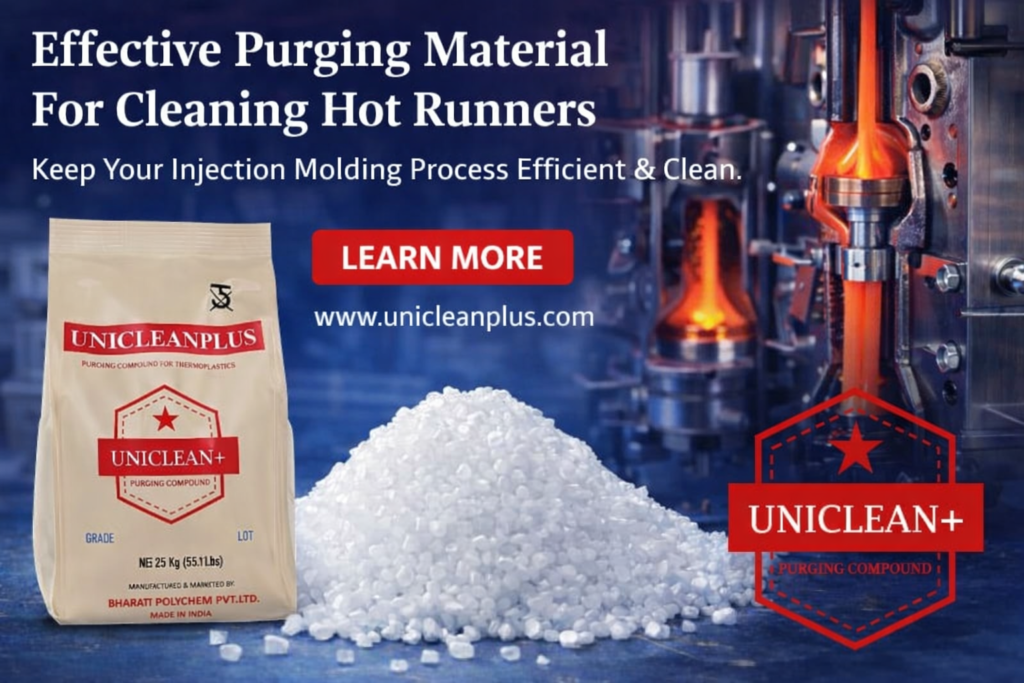
Working with solutions from Unicleanplus helps because their compounds are designed for high-temperature applications like hot runners, not just standard barrels. That difference matters when cleaning becomes difficult.
Timing Is Critical
One mistake that shows up often — waiting too long.
If you only clean after defects appear, you’re already dealing with buildup that has hardened inside the system.
Regular purging between color or material changes helps avoid that stage completely. It’s not extra work. It actually reduces interruptions later.
That’s one of the simplest ways to reduce downtime injection molding without changing the entire process.
A few practical things that still help
Even with proper purging, small habits matter:
- avoid overheating material unnecessarily
- don’t leave resin sitting idle in hot runners
- match purging compound to polymer type
- keep cleaning intervals consistent
These won’t replace proper cleaning, but they prevent buildup from getting worse.
FAQs
Why are hot runners difficult to clean?
Because residue builds up in small internal channels that are not easy to reach.
Can I clean hot runners using regular resin?
You can try, but it usually doesn’t remove deep contamination.
How often should hot runners be cleaned?
It depends on production cycles, but regular purging helps avoid major buildup.
Does purging damage the system?
No, when using the correct compound designed for your machine and material.
What happens if hot runners are not cleaned properly?
You’ll start seeing defects like streaks, black specks, and inconsistent flow.
Bottom Line
Cleaning hot runners is one of those tasks that seems simple until it isn’t.
If buildup isn’t removed properly, it keeps affecting production in small ways that add up over time.
Using the right approach, along with reliable solutions from Unicleanplus, helps keep the system clean without constant trial and error. And in most cases, that’s what teams are trying to avoid — repeating the same problem every few cycles.